
 AI Search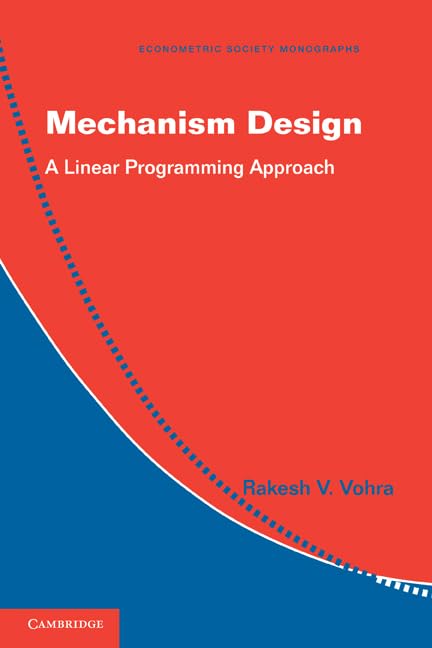
Mechanism design : a linear programming approach / Rakesh V. Vohra.
Material type: TextSeries: Econometric Society monographs ; 47Publication details: Cambridge ; New York : Cambridge University Press, 2011.Description: 172 p. : illISBN:
 - 9781107004368
- 9780521179461
- HD30.23 V888 M 2011
 English Books
| Cover image | Item type | Current library | Home library | Collection | Shelving location | Call number | Materials specified | Vol info | URL | Copy number | Status | Notes | Date due | Barcode | Item holds | Item hold queue priority | Course reserves | |
|---|---|---|---|---|---|---|---|---|---|---|---|---|---|---|---|---|---|---|
|
English Books
|
MATRIX Library General Eng/FL.3 | General Books | HD30.23 V888 M 2011 (Browse shelf(Opens below)) | C.1 | Available | 1000385869 |
Browsing MATRIX Library shelves,Shelving location: General Eng/FL.3,Collection: General Books Close shelf browser (Hides shelf browser)

|

|

|

|

|

|

|
||
| HD30.23 H236 2010 Handbook of decision making / | HD30.23 N687 T 2008 Think smart-act smart : | avoiding the business mistakes that even intelligent people make / | HD30.23 T333 I5 2023 The Innovation tournament handbook : | a step-by-step guide to finding exceptional solutions to any challenge / | HD30.23 V888 M 2011 Mechanism design : | a linear programming approach / | HD30.25 Q1 2013 Quantitative modelling in marketing and management / | HD30.28 A469 N 2010 Needs assessment. Phase I : | getting started / | HD30.28 A469 N 2010 Needs assessment : | an overview / |
Machine generated contents note: 1. Introduction; 2. Arrow's theorem and its consequences; 3. Network flow problem; 4. Incentive compatibility; 5. Efficiency; 6. Revenue maximization; 7. Rationalizability.
HKBU library
YT2025 M08
"Mechanism design is an analytical framework for thinking clearly and carefully about what exactly a given institution can achieve when the information necessary to make decisions is dispersed and privately held. This analysis provides an account of the underlying mathematics of mechanism design based on linear programming. Three advantages characterize the approach. The first is simplicity: arguments based on linear programming are both elementary and transparent. The second is unity: the machinery of linear programming provides a way to unify results from disparate areas of mechanism design. The third is reach: the technique offers the ability to solve problems that appear to be beyond solutions offered by traditional methods. No claim is made that the approach advocated should supplant traditional mathematical machinery. Rather, the approach represents an addition to the tools of the economic theorist who proposes to understand economic phenomena through the lens of mechanism design"--
There are no comments on this title.