
 AI Search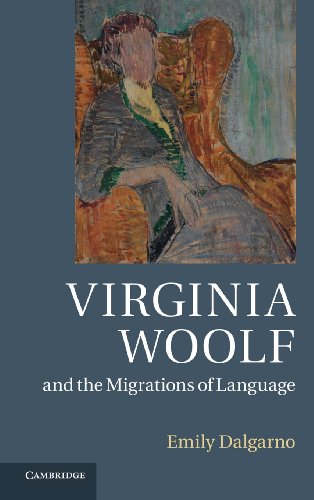
Virginia Woolf and the migrations of language / Emily Dalgarno.
Material type: TextPublication details: Cambridge ; New York : Cambridge University Press, 2012.Description: 215 pISBN:
 - 9781107010185
- PR6045 D142 V 2012
 English Books
| Cover image | Item type | Current library | Home library | Collection | Shelving location | Call number | Materials specified | Vol info | URL | Copy number | Status | Notes | Date due | Barcode | Item holds | Item hold queue priority | Course reserves | |
|---|---|---|---|---|---|---|---|---|---|---|---|---|---|---|---|---|---|---|
|
English Books
|
MATRIX Library General Eng/FL.3 | General Books | PR6045 D142 V 2012 (Browse shelf(Opens below)) | C.1 | Available | 1000374036 |
HKBU Library
"Virginia Woolf's rich and imaginative use of language was partly a result of her keen interest in foreign literatures and languages - mainly Greek and French, but also Russian, German and Italian. As a translator she naturally addressed herself both to contemporary standards of translation within the university, but also to readers like herself. In Three Guineas she ranged herself among German scholars who used Antigone to critique European politics of the 1930s. Orlando outwits the censors with a strategy that focuses on Proust's untranslatable word. The Waves and The Years show her looking ahead to the problems of postcolonial society, where translation crosses borders. In this first in-depth study of Woolf and European languages and literatures, Emily Dalgarno opens up a rewarding new way of reading her prose"--
"The need to change the structure of the English sentence in order better to meet the requirements of women writers is a constant theme in the work of Virginia Woolf. She wrote during a period when the goals of translation were undergoing fundamental changes that enlarged and facilitated that project. The British translator who was compelled to observe the ethnocentric standards of Greek translation in the university evolved within a few decades into a figure whose aim, in response to the demands of colonial readers, was to mediate between cultures. It is the argument of this book that although Woolf read translations to acquaint herself with the diverse cultures of the world, as a writer she quickly learned to use translation as a means to resist the tendency of the dominant language to control meaning, the first step to remodeling semantics and syntax"--
There are no comments on this title.