
 AI Search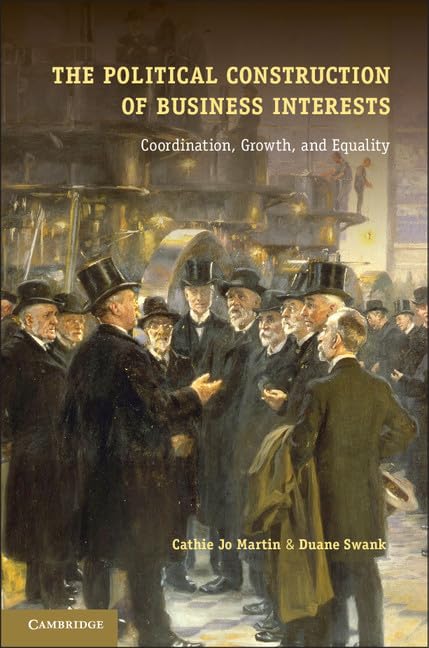
The political construction of business interests : coordination, growth, and equality / Cathie Jo Martin, Boston University, Duane Swank, Marquette University.
Material type: TextSeries: Cambridge studies in comparative politicsPublication details: New York : Cambridge University Press, 2012.Description: 307 p. : illISBN:
 - 9781107018662
- 9781107603646
- HD3611 M379 P 2012
 English Books
| Cover image | Item type | Current library | Home library | Collection | Shelving location | Call number | Materials specified | Vol info | URL | Copy number | Status | Notes | Date due | Barcode | Item holds | Item hold queue priority | Course reserves | |
|---|---|---|---|---|---|---|---|---|---|---|---|---|---|---|---|---|---|---|
|
English Books
|
MATRIX Library General Eng/FL.3 | General Books | HD3611 M379 P 2012 (Browse shelf(Opens below)) | C.1 | Available | 1000360813 |
Browsing MATRIX Library shelves,Shelving location: General Eng/FL.3,Collection: General Books Close shelf browser (Hides shelf browser)

|

|

|

|

|

|

|
||
| HD2910 W246 C 2008 Contractual joint ventures in China : | formation, evolution and operation / | HD2910.Z8 K49 C 2013 Chinese labor in a Korean factory : | class, ethnicity, and productivity on the shop floor in globalizing China / | HD3575 D489 2012 Development cooperation and emerging powers : | new partners or old patterns? / | HD3611 M379 P 2012 The political construction of business interests : | coordination, growth, and equality / | HD3616 B976 2004 Business and industry in Nazi Germany / | HD3616.E8 R344 1996 Regulating Europe / | HD3616 H873 C 2011 China's regulatory state : | a new strategy for globalization / |
HKBU Library
"Many societies use labor market coordination to maximize economic growth and equality, yet employers' willing cooperation with government and labor is something of a mystery. The Political Construction of Corporate Interests recounts employers' struggles to define their collective social identities at turning points in capitalist development. Employers are most likely to support social investments in countries with strong peak business associations, that help members form collective preferences and realize policy goals in labor market negotiations. Politicians, with incentives shaped by governmental structures, took the initiative in association-building and those that created the strongest associations were motivated to evade labor radicalism and to preempt parliamentary democratization. Sweeping in its historical and cross-national reach, the book builds on original archival data, interviews, and cross-national quantitative analyses. The research has important implications for the construction of business as a social class and powerful ramifications for equality, welfare state restructuring and social solidarity"--
There are no comments on this title.