
 AI Search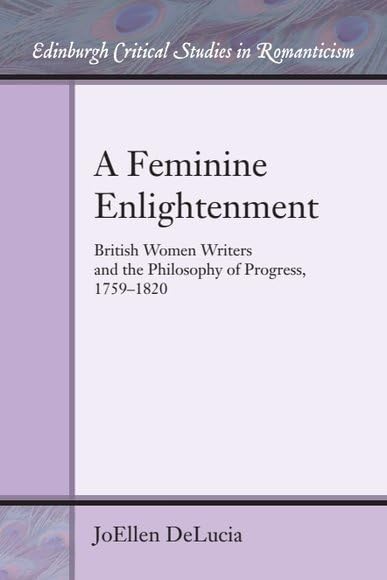
A feminine enlightenment : British women writers and the philosophy of progress, 1759-1820 / JoEllen DeLucia.
Material type: TextSeries: Publication details: Edinburgh : Edinburgh University Press, 2015Description: 208 pISBN:
 - 9780748695942
- 074869594X
- PR448 D366 F 2015
 English Books
| Cover image | Item type | Current library | Home library | Collection | Shelving location | Call number | Materials specified | Vol info | URL | Copy number | Status | Notes | Date due | Barcode | Item holds | Item hold queue priority | Course reserves | |
|---|---|---|---|---|---|---|---|---|---|---|---|---|---|---|---|---|---|---|
|
English Books
|
MATRIX Library General Eng/FL.3 | General Books | PR448 D366 F 2015 (Browse shelf(Opens below)) | C.1 | Available | 1000373450 |
Browsing MATRIX Library shelves,Shelving location: General Eng/FL.3,Collection: General Books Close shelf browser (Hides shelf browser)

|

|

|

|

|

|

|
||
| PR418 K33 U 2004 Utopia, carnival, and commonwealth in Renaissance England / | PR428 O51 I 2008 The imperfect friend : | emotion and rhetoric in Sidney, Milton, and their contexts / | PR438 G834 P 2013 The poetics and politics of youth in Milton's England / | PR448 D366 F 2015 A feminine enlightenment : | British women writers and the philosophy of progress, 1759-1820 / | PR448 G184 R 2000 Romanticism and the Gothic : | genre, reception, and canon formation / | PR448.G6 W721 A 1995 Art of darkness : | a poetics of Gothic / | PR448 L669 2003 Lewd & notorious : | female transgression in the eighteenth century / |
HKBU Library
Revises established understandings of British women writers' contributions to Enlightenment narratives of social and historical progress Drawing on original archival research, A Feminine Enlightenment argues that women writers shaped Enlightenment conversations regarding the role of sentiment and gender in the civilizing process. By reading women's literature alongside history and philosophy and moving between the eighteenth century and Romantic era, JoEllen DeLucia challenges conventional historical and generic boundaries. Beginning with Adam Smith's Theory of Moral Sentiments (1759), she tracks discussions of "women's progress" from the rarified atmosphere of mid-eighteenth-century Bluestocking salons and the masculine domain of the Scottish university system to the popular Minerva Press novels of the early nineteenth century. Ultimately, this study positions feminine genres such as the Gothic romance and Bluestocking poetry, usually seen as outliers in a masculine Age of Reason, as essential to understanding emotion's role in Enlightenment narratives of progress. The effect of this study is twofold: to show how developments in women's literature reflected and engaged with Enlightenment discussions of emotion, sentiment, and commercial and imperial expansion; and to provide new literary and historical contexts for contemporary conversations that continue to use "women's progress" to assign cultures and societies around the globe a place in universalizing schemas of development. --Provided by publisher.
There are no comments on this title.