
 AI Search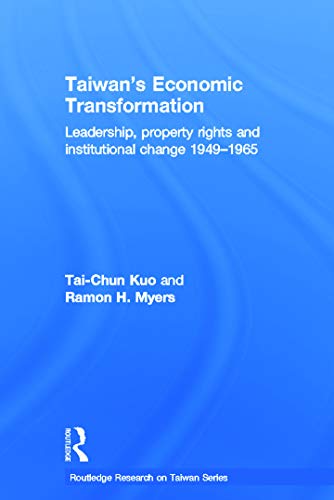
Taiwan's economic transformation : leadership, property rights and institutional change 1949-1965 / Tai-Chun Kuo and Ramon H. Myers.
Material type: TextSeries: Routledge research on Taiwan ; 7Publication details: London ; New York : Routledge, 2012.Description: 164 p. : illISBN:
 - 9780415665902
- 0415665906
- 9780203808016
- 0203808010
- HC430.5 K96 T 2012
 English Books
| Cover image | Item type | Current library | Home library | Collection | Shelving location | Call number | Materials specified | Vol info | URL | Copy number | Status | Notes | Date due | Barcode | Item holds | Item hold queue priority | Course reserves | |
|---|---|---|---|---|---|---|---|---|---|---|---|---|---|---|---|---|---|---|
|
English Books
|
MATRIX Library General Eng/FL.3 | General Books | HC430.5 K96 T 2012 (Browse shelf(Opens below)) | C.1 | Available | 1000371709 |
HKBU Library
"This book charts the period before Taiwan's post-war economic miracle took hold (1949-1965) and proffers that it was the Kuomintang Government's endorsement of property rights reform and institutional change that enabled Taiwan to transform from an impoverished command economy to a market-based economy, which in turn led to Taiwan becoming one of the fastest growing economies in the world. Using first-hand interview material with key government officials from the period, and analysis of hitherto unused Chinese-language archives, this book is empirically very rich. It also gives the reader insights into Taiwan's developmental experience and the direction in which, under different circumstances, China's post-war development might have proceeded. <EM>Taiwan's Economic Transition</EM> will be an invaluable resource for anyone interested in the economic and political history and development of Taiwan. More broadly it will also appeal to scholars and students of China's historical and contemporary development"--
"This book tells the story of Taiwan's economic revolution--how Taiwan transformed itself from a planned economy into a market economy between 1949 and 1965. The authors posit that it was the Kuomintang Government's endorsement of property rights reform and institutional change that enabled Taiwan to transform from an impoverished command economy to one of the fastest growing economies in the world. The book gives special attention to how a small group of political and economic leaders began adopting the new ideas and beliefs that created the vision that enabled them to embrace institutional and organizational innovations, actions which led to the formation of the new market economy. Using first-hand interview material with key government officials from the period, and analyses of hitherto unused Chinese-language archives including: the diaries of Chiang Kai-shek, Kuomintang party archives, and personal papers of Kuomintang leaders, as well as newspaper and journal articles published in Taiwan between 1949 and 1965, this book is both empirically rich, and gives the reader insights into Taiwan's developmental experience and the direction in which, under different circumstances, China's post-war expansion might have proceeded. Taiwan's Economic Transition will be an invaluable resource for anyone interested in the economic and political history and development of Taiwan. More broadly it will also appeal to scholars and students of China's historical and contemporary development, Asian economics, and Asian studies"--
There are no comments on this title.